|
The Great Alligator Film review by Thomas M. Sipos |

|
MENU Books Horror Film Festivals and Awards
Pursuits
Blogs Horror Film Festivals and Awards
Other
|
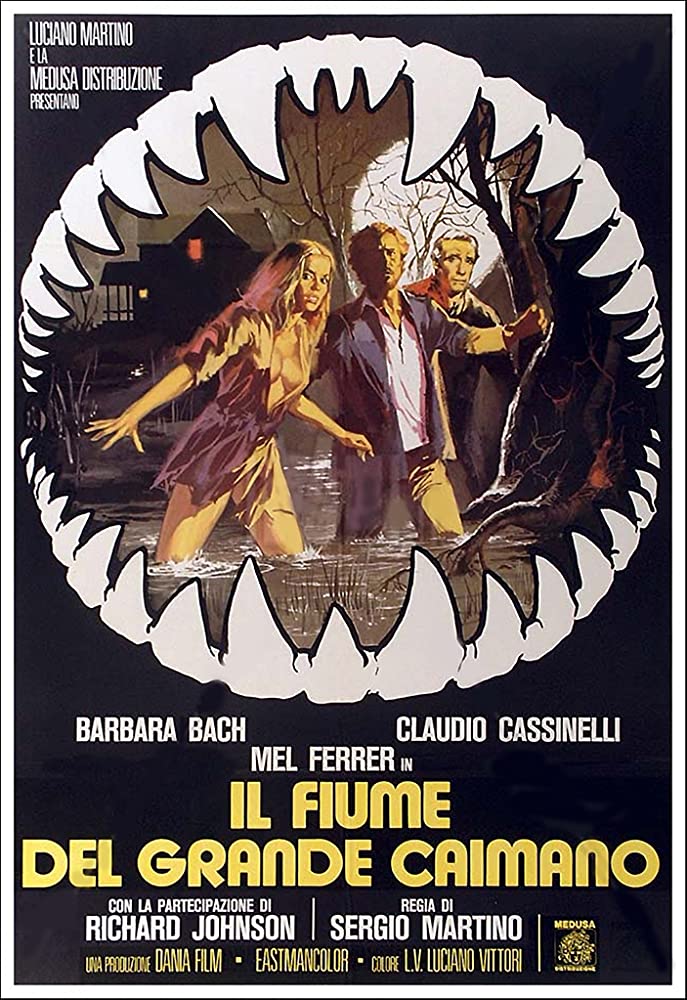
The Great Alligator (1979, Italian, aka Big Alligator River, Alligators, Il Fiume del grande caimano, dir: Sergio Martino; cast: Barbara Bach, Mel Ferrer, Richard Johnson, Claudio Cassinelli, Romano Puppo)
Evil Below and The Great Alligator are my favorites. Evil Below is noteworthy for its unusual mix of demonism and undersea horror. A Caribbean treasure hunt thriller with borrowings from Satan's Triangle and Jaws. But The Great Alligator is better still. Cheesy, shamelessly derivative, stunningly stupid, and enormously enjoyable. In other words, your typical low-budget Italian ripoff. You already know the plot. You've seen it before. Here it is again: A greedy white businessman (Mel Ferrer) opens an ostentatious hotel in a third world jungle. His timing is awful. Something in the river has begun killing people. The nearby natives think it's the "great god Kruna," who is angry at them for associating with white men. No, it's not Kruna. You know what it is. The film's title is kind of a giveaway. Anyway, as you'd expect, Ferrer attempts the usual coverup, lest the tourist trade dry up. The heroes (Barbara Bach and Claudio Cassinelli) suspect something fishy going on, what with all those missing people. Happily, their warnings prove futile. The body count is generous indeed. One of the fun things about The Great Alligator is that the victims are so boorish or thinly sketched that one is free to enjoy the alligator attacks. The victims are more colorful than in most slasher films, but in the broad strokes of caricature rather than character. And remarkably un-PC caricatures. Apart from its relative obscurity, I'm guessing one reason the film has avoided PC outrage is because its story is so stupid, it's hard to take seriously. Another reason is that the mostly white tourists are as unflattering as the colored natives. It's difficult deciding who comes off worse. The tourists are fat, greedy, lustful, stupid, and disrespectful of the environment (drunkenly shooting monkeys from the safety of a boat). Ugly Americans, boorish Germans, eccentric Brits. (One Brit matron expounds upon UFOs, for no particular reason). There's even an obnoxiously preconscious brat to offer inappropriate commentary on the adults' sexcapades. As for the indigenous tribesmen, they're cruel, savage, primitive, superstitious, fearful, stupid, and ignorant of science (offering Bach as live human sacrifice to their "great god Kruna"). And in case one human sacrifice proves inadequate to appease Kruna, the natives attack the hotel, slaughtering tourists with gusto. Just last night, these tribesmen were happily performing colorful native dances for the tourists, in exchange for such fabulous gifts as pants and alcohol. Now, they resemble the sadistic savages from Make Them Die Slowly, implying that, while you can take the BLANK out of the jungle, you can't take the jungle out of the BLANK. (We'll let Archie Bunker complete those blanks).
The Great Alligator is that rare dialectic, synthesizing opposing stereotypes into a remarkably inane ending. (More on the ending later.) Perhaps realizing its potentially offensive content, the film explicitly (if artificially) disavows both stereotypes. Ferrer expounds his respect for the environment, and physically stops a paying tourist from shooting monkeys. Meanwhile, Bach offers running commentary throughout the film, lecturing Cassinelli about her respect for the natives. Bach's character would know. She's an anthropologist working as a hotel guide. It was the only way she could afford to come study the local natives. Cassinelli is the hunky photographer in khaki, hired to take publicity shots for the hotel opening. We know he's eco-sensitive because he chides a gamekeeper who is feeding live animals to crocodiles (as though crocs, uncorrupted by Man, are veggies at heart). Naturally, one suspects Cassinelli would rather do serious photojournalism. And just as naturally, Cassinelli and Bach become "an item," as they were before in Screamers. (How it is that beautiful lead women are always unattached in these films? I know it's to make them available to the newcomer heroes, but still...) Director Martino makes admirably creative use of his limited resources. The low-budget alligator only rarely looks like a stiffly floating prop, because (1) Martino's camera constantly pans across the alligator, (2) which is shot largely in closeups, and (3) edited into brief shots. Thus, we rarely see the alligator prop as a whole, but rather only see brief closeups moving across the screen. When we do see its entire body (usually from underwater, so even then it's partly obscured) it's apparent that its legs are still, despite its being propelled across screen.
 When the alligator munches upon tourists, its stiff jaws are shot descending on screaming actors, intercut with bloody water. But we don't see flesh pierced. The body count is high, but the gore is almost suggested, as in Psycho (where you saw blood, but no cutting). The Great Alligator is a poor man's gore film. For that matter, even the natives are a poor man's savage tribe. I'd seen The Great Alligator several times before I realized that I never really knew the story's location. In the opening shots, the jungle and river resemble the Amazon basin, yet the natives look African, not South American. One of them even refers to "your black woman." But the grass-covered boats and props -- more than anything else, they look Polynesian. So are we in the South Pacific? Come to think of it, the "Africans" look a bit like Australian aborigines, albeit tallish aborigines. The end credits claim the film was shot in ... Sri Lanka. Okay, so I guess that's what Sri Lanka looks like. Yet, I wonder... The natives, their village, the tour boat -- they look as though the filmmakers grabbed whatever props and extras were available on the cheap. Anything that evoked "third world jungle." A grabbag mishmash, with little regard for consistency or authenticity. I don't know, does "Kruna" even sound Sri Lankan? About that inane ending (skip the next paragraph to avoid a "spoiler") ...
The natives have slaughtered half the tourists, and nearly killed Bach. Bach and Cassinelli have returned to the resort, huddling amid the surviving tourists. The armed natives emerge from the jungle. Bach, Cassinelli, the tourists -- all gasp! Will the natives finish them off? But then the natives see the dead alligator (killed by Cassinelli, via a method lifted straight out of Jaws, to be lifted again in Evil Below). Some natives prod the dead alligator, then one announces that Kruna is dead! All natives cheer! Bach grins warmly. Cassinelli, the tourists, the brat, everyone, grins warmly. The natives grin warmly. Kruna is dead, so there will be no more slaughter. Everyone is friends again. All previous slaughter is forgotten and forgiven. Happy music swells. End credits roll. HUH?! A final note. The Great Alligator features some truly awful day-for-night shots, although that's hard to avoid if you want to shoot a large expanse of river. Even so, it's a dark "nighttime" in some scenes, and practically daylight soon thereafter. Still, The Great Alligator is immensely enjoyable despite its inanities and budgetary shortcomings. Richard Johnson, in a cameo as a mad Christian missionary, hams it up with some campy dialogue. Bach's wet clothes cling diaphanously to her firm body. And you got a big alligator (at times resembling a flotation device) chomping down boatloads of screaming tourists and natives. What more can you ask? Review copyright by Thomas M. Sipos
|
 As with
every boxoffice success,
As with
every boxoffice success, 
"Communist Vampires" and "CommunistVampires.com" trademarks are currently unregistered, but pending registration upon need for protection against improper use. The idea of marketing these terms as a commodity is a protected idea under the Lanham Act. 15 U.S.C. s 1114(1) (1994) (defining a trademark infringement claim when the plaintiff has a registered mark); 15 U.S.C. s 1125(a) (1994) (defining an action for unfair competition in the context of trademark infringement when the plaintiff holds an unregistered mark).